Simulating Galaxy Formation
Durham has a rich history of simulating the intertwined formation of galaxies and large scale structure of the universe using hydrodynamic methods. In the last 15 years, it has remained at the forefront of this field. In the late 2000s, we performed the GIMIC and OWLS simulations, leading in the 2010s to the pivotal EAGLE simulation, which was the first to create realistic-looking galaxies in a cosmological volume.
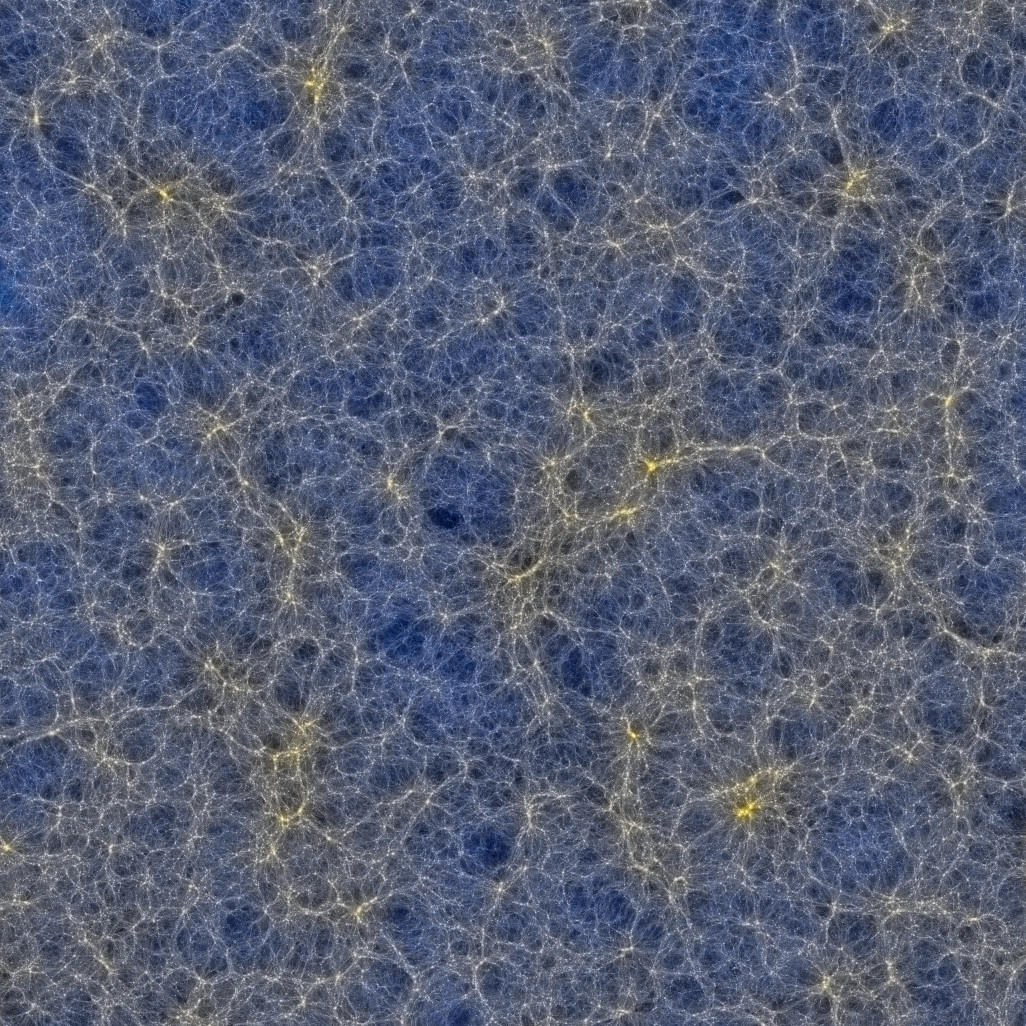 That tradition continues today through two major successors to EAGLE, both projects of the Virgo
Consortium run in Durham on the COSMA supercomputer,
operated by the ICC on behalf of DiRAC. The
FLAMINGO project is the largest
hydrodynamical simulation of the universe ever
evolved to the present day: its flagship run follows 300 billion particles, including massive
neutrinos, in a box 2.8 Gpc on a side, providing the theoretical counterpart to large-scale
structure surveys such as Euclid and Rubin-LSST. Its companion,
COLIBRE, takes the physics in the opposite
direction: it is the first large-volume simulation suite to model the cold, dusty interstellar
medium directly, without the temperature floors of earlier generations, allowing detailed
confrontation with observations from JWST and ALMA. Both projects are powered by the
SWIFT code, whose development began at the ICC, and both
were calibrated using emulator-based statistical techniques developed in collaboration with
mathematicians in Durham.
That tradition continues today through two major successors to EAGLE, both projects of the Virgo
Consortium run in Durham on the COSMA supercomputer,
operated by the ICC on behalf of DiRAC. The
FLAMINGO project is the largest
hydrodynamical simulation of the universe ever
evolved to the present day: its flagship run follows 300 billion particles, including massive
neutrinos, in a box 2.8 Gpc on a side, providing the theoretical counterpart to large-scale
structure surveys such as Euclid and Rubin-LSST. Its companion,
COLIBRE, takes the physics in the opposite
direction: it is the first large-volume simulation suite to model the cold, dusty interstellar
medium directly, without the temperature floors of earlier generations, allowing detailed
confrontation with observations from JWST and ALMA. Both projects are powered by the
SWIFT code, whose development began at the ICC, and both
were calibrated using emulator-based statistical techniques developed in collaboration with
mathematicians in Durham.
In parallel, Durham is a core partner in the MillenniumTNG project, together with the Max Planck Institute for Astrophysics and the Center for Astrophysics at Harvard. MillenniumTNG marries the galaxy formation model of IllustrisTNG with the enormous volumes pioneered by our iconic early-2000s Millennium simulation, combining a full hydrodynamical calculation in a 740 Mpc box with a trillion-particle dark-matter-only run spanning 3 Gpc. A crucial ingredient is the use of semi-analytic galaxy formation models to transfer the galaxy populations of the hydrodynamical run onto the vast volumes and lightcones of the N-body calculations, bridging the gap between detailed galaxy physics and precision cosmology.
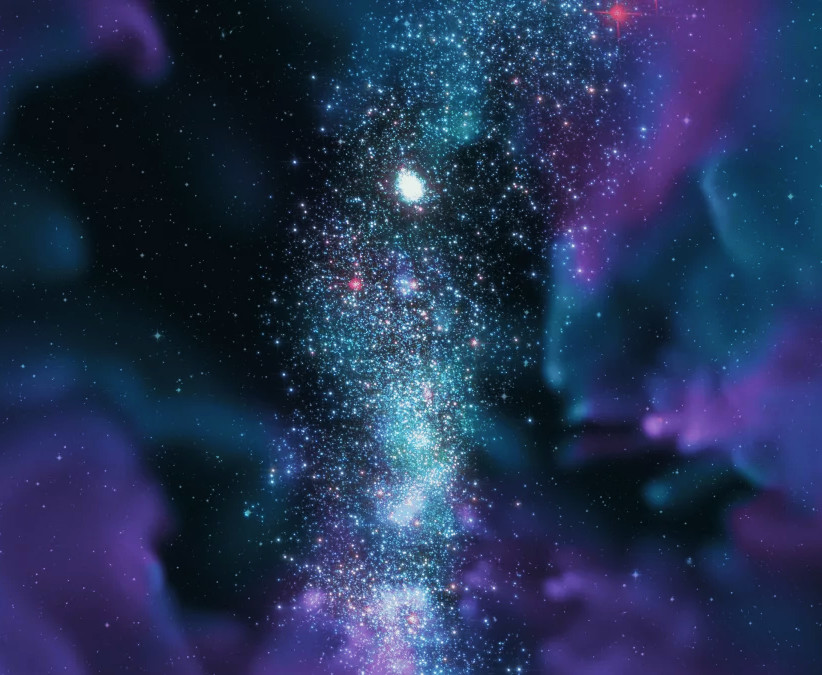 Alongside these large volumes, ICC researchers develop "zoom" simulations that concentrate
computational power on individual galaxies at extraordinary resolution. For example, the
Auriga Superstars
suite resimulates Milky Way-like galaxies with star
particles of just 800 solar masses, revealing the fine structure of bars, spiral arms and stellar haloes in the era of
Gaia. The
EDGE collaboration simulates the
faintest dwarf galaxies in the universe at parsec-scale resolution
with radiation hydrodynamics, using the "genetic modification" technique to perform controlled
experiments on how galaxies respond to changes in their cosmological initial conditions.
Alongside these large volumes, ICC researchers develop "zoom" simulations that concentrate
computational power on individual galaxies at extraordinary resolution. For example, the
Auriga Superstars
suite resimulates Milky Way-like galaxies with star
particles of just 800 solar masses, revealing the fine structure of bars, spiral arms and stellar haloes in the era of
Gaia. The
EDGE collaboration simulates the
faintest dwarf galaxies in the universe at parsec-scale resolution
with radiation hydrodynamics, using the "genetic modification" technique to perform controlled
experiments on how galaxies respond to changes in their cosmological initial conditions.
Together these projects form a programme spanning nine orders of magnitude in scale, from the cold clouds in which individual stars form to the largest structures in the observable universe. They reflect the way modern computational cosmology is done: through international collaborations in which the ICC supplies physical insight, simulation codes, leadership and supercomputing expertise. As exascale computing arrives and multimessenger surveys transform observational cosmology, our ambition is to provide the virtual universes against which our understanding of galaxy formation is tested and challenged.