The Gigaparsec universe
The ICC has a vigorous research program to simulate the Universe on giga-parsec scales and to compare the simulation results with upcoming wide-field surveys. Highlights include:- Modelling galaxy clustering in redshift space.
Peculiar velocities are potentially a powerful probe of gravity but to exploit this we need accurate models (Hernandez-Aguayo et al. 2019, Cuesta-Lazaro et al. 2020). - Which galaxies are the best tracers of large-scale structure?
Upcoming surveys will target a range of galaxies to probe the large-scale structure of the Universe. We have used galaxy formation models to predict the clustering and halo occupation distributions of emission line galaxies ( Gonzalez-Perez et al.) and to test how well different selection trace baryonic acoustic oscillations (Hernandez-Aguayo et al. 2019).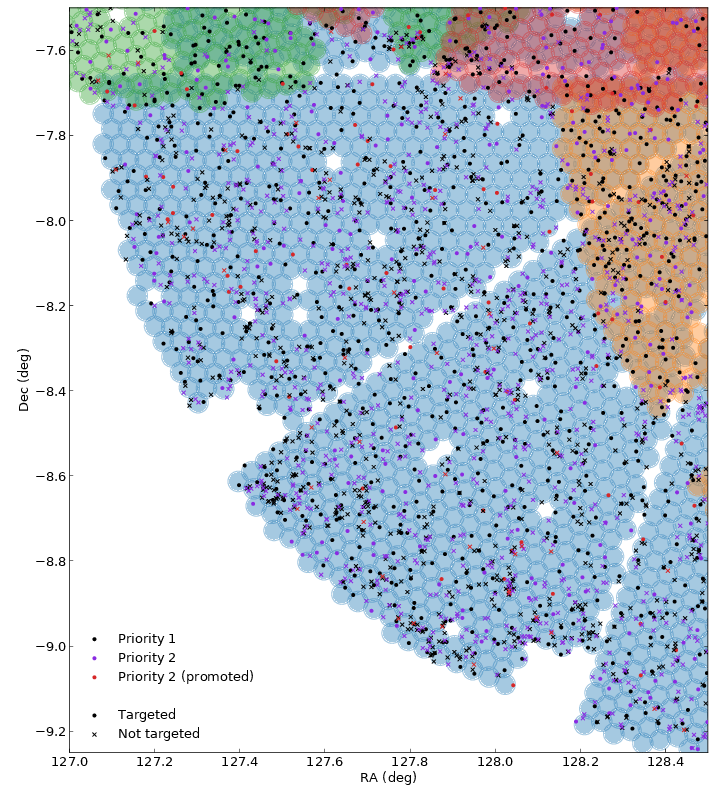
An illustration of the use of the MXXL mocks from Smith et al. 2017 to test the fibre assignment and mitigation (see Smith et al 2019). - Mock catalogues for upcoming surveys.
We have built a mock DESI Bright Galaxy Survey catalogue using the MXXL simulation (Smith et al. 2017) which has been used to test the impact of the fibre assignment algorithm on galaxy clustering (Smith et al. 2019). We have also built mocks for the PAU Camera Survey using GALFORM (Stothert et al. 2018) and used this to devise a novel way to find galaxy groups (Stothert et al. 2019).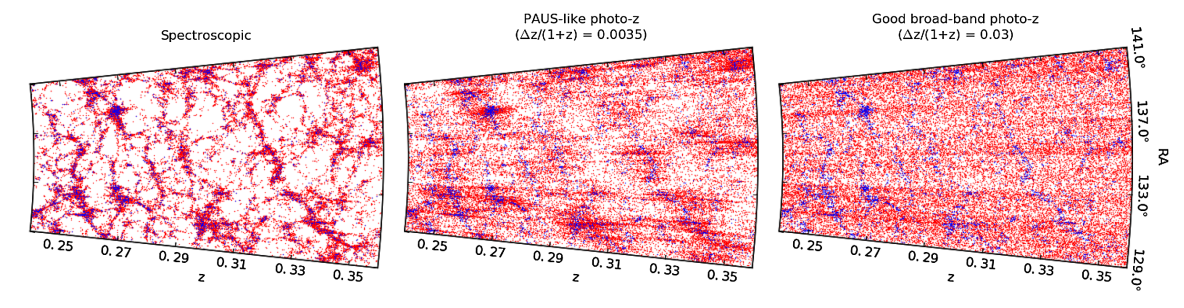
The spatial distribution of galaxies in a 1 deg thick slice from the PAUS mock catalogue. The three panels show the spatial distribution with spectroscopic redshift resolution (left), with PAUS-like redshift resolution (centre) and for typical broad-band redshift resolution (right). The red points are galaxies brighter than the PAUS magnitude limit i = 23, while the blue points correspond to GAMA galaxies (r < 19.8) with the spectroscopic redshift. - Weak lensing peaks and voids as a new cosmological probe
Future galaxy surveys will produce accurate maps of weak gravity lensing, and offer the potential of extracting other useful statistics beyond the two-point correlation function of cosmic shear, such as the abundances and profiles of peaks (Davies et al. 2019) and voids (Davies et al. 2018). - Reconstruction of the initial condition of the Universe
The nonlinear clustering of matter at late times poses a big challenge in the extraction of the cosmological information from observed galaxy distributions. Undoing this nonlinear evolution can be useful for, e.g., accurately determining the position of the baryonic accoustic oscillations peal, and therefore measuring the expansion history of the Univesre. Shi et al. 2018 and Birkin et al. 2019 developed a new method for this initial condition reconstruction. Wang et al. 2019 further extended the method to remove the redshift-space distortions from observed galaxy catalogues and extract information about the cosmic density and peculiar velocity fields. - Extracting higher-order statistics from galaxy surveys
The analysis of galaxy survey data relies heavily on the measurement of two-point statistics. Higher-order statistics, such as the bispectrum, offer complimentary information by probing more complex patterns of the cosmic web and thus entail the potential of signnificantly improving our parameter constraints. In particular, by breaking degeneracies prevalent in two-point statistics they precisely measure the growth rate of structures and allow us to conduct accurate tests of general relativity on large scales. In addition, higher-oder statistics can provide direct measurements of eventual primordial non-Gaussianities, which opens a window into the earliest phase of our Universe. In Durham we develop models of the bispectrum that include all relevant effects from galaxy bias and redshift-space distortions in order to enable a robust application to upcoming survey data (Eggemeier et al. 2019). We implement such models in analysis pipelines that we test against the output from simulated mock catalogues.