Outreach

Outreach & media

Sharing the wonders of the cosmos with the public is a vital part of the scientific journey.

Watch “What’s a micronova?” on YouTube

Featured discovery

What’s a micronova?

Micronovae are thermonuclear explosions confined to small regions near the magnetic poles of accreting white dwarfs. Discovered in optical timing data from NASA’s TESS mission, each burst releases about a millionth of the energy of a classical nova.

We believe the white dwarf’s magnetic field acts as a funnel, confining fresh material onto the stellar poles (somewhat like the aurorae on Earth). This magnetic bottleneck lets the pressure and temperature needed for ignition build up much faster, so far less material is needed than for a global classical nova.

Because the bursts fade within a few hours they are easy to miss, which explains why they went undetected for decades. Read the Nature paper.

Videos, sound and images

  • Magnetically gated accretion in MV Lyrae

    An animation of the brightness variations of MV Lyrae observed by Kepler. Gas piles up at the magnetospheric boundary and periodically overcomes the magnetic barrier, producing accretion bursts every two hours.
    Watch on YouTube: Magnetically gated accretion in MV Lyrae

  • Globular cluster M4 in K2

    A three-month time-lapse of the globular cluster M4 captured by NASA’s K2 mission. The pulsating points are old RR Lyrae variables, cycling through temperature and opacity changes.

    Watch on YouTube: Globular cluster M4 in K2

  • Acoustic astronomy

    The munching sound of the cosmos

    Accretion discs emit light that flickers on timescales from milliseconds to days. By turning these light curves into audio and shifting their frequencies into the range of human hearing, we can “listen” to how cosmic engines grow.

    • Track 1: Earth–Sun-scale disc
    • Track 2: Large accretion disc
    • Track 3: Medium accretion disc
    • Track 4: Stellar-mass black hole
    • Track 5: Small, city-scale disc

    Watch the explanatory video

    Selected press: HuffPost · Space.com

  • Astrophotography

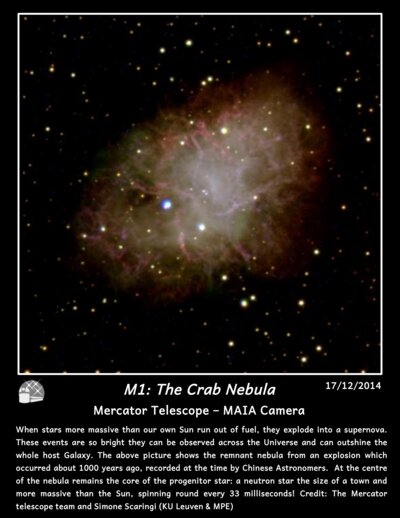
    The Crab Nebula through the eyes of MAIA

    Thumbnail of the Crab Nebula poster

    A composite image of the Crab Nebula supernova remnant, taken with the MAIA camera on the 1.2-metre Mercator Telescope on La Palma and combining r-, g- and u-band exposures.

    Download the poster PDF, 95 KB